


Wonder Workshop: Taking a First Step
> Ready to switch on your curiosity? - a workshop designed to help you develop the skill to sketch and explore. Not a how-to, but a series of playful prompts to wake your creative instincts.
> Creativity is not the same as crafting: it means generating original ideas or outcomes that are meaningful or useful within a given context. Craft, however, is one way to achieve this.
> Working with your hands doesn’t just produce objects: it links thinking and sensing, makes ideas visible, encourages experimentation, and deepens understanding of materials and processes.
> Cognition is not confined to the brain: tools, objects and material actions act as extensions of the body and memory, actively shaping intentions, meanings and the way problems are solved.
> The philosophical upshot, in one line: Thinking is a practice that arises in the interaction between person, body and material world; objects are active components of cognition, not neutral outputs.
How?
> By experimenting with printing techniques and found materials. Techniques that are easy to repeat at home or at your workplace.
> By formulating and comparing our definitions of words like “opinion” and “judgment,” words we encounter in every process of our lives: simultaneously analyzing when they help and when they block.
> By formulating a playful personal question: a way to spark curiosity, challenge assumptions, postpone judgments, and let direction emerge. Questions such as:
What if everyone lived in a tent?
Or everything is red, or nothing is round?
What does the smell of soil look like?
> By taking part: open up to play, be curious, and try to quiet your inner critic for a while. Creativity is a skill anyone can learn.
> What will you take away? New experiences, your first creative research booklet, small models, or something entirely unexpected. The route is open — the aim is to let go of the idea of a fixed end result and to see what appears.
> It's like starting to ride a bike — every time you begin it's wobbly, but then you find your balance.
How?
Why?
> Instead of feeling stuck, you learn to seek new routes and value what’s happening now, not what’s expected. (Social) rules are agreements—and therefore flexible and changeable.
> When you have mastered the core thinking skills—remembering, understanding, applying, analysing and evaluating—you ultimately arrive at creating.
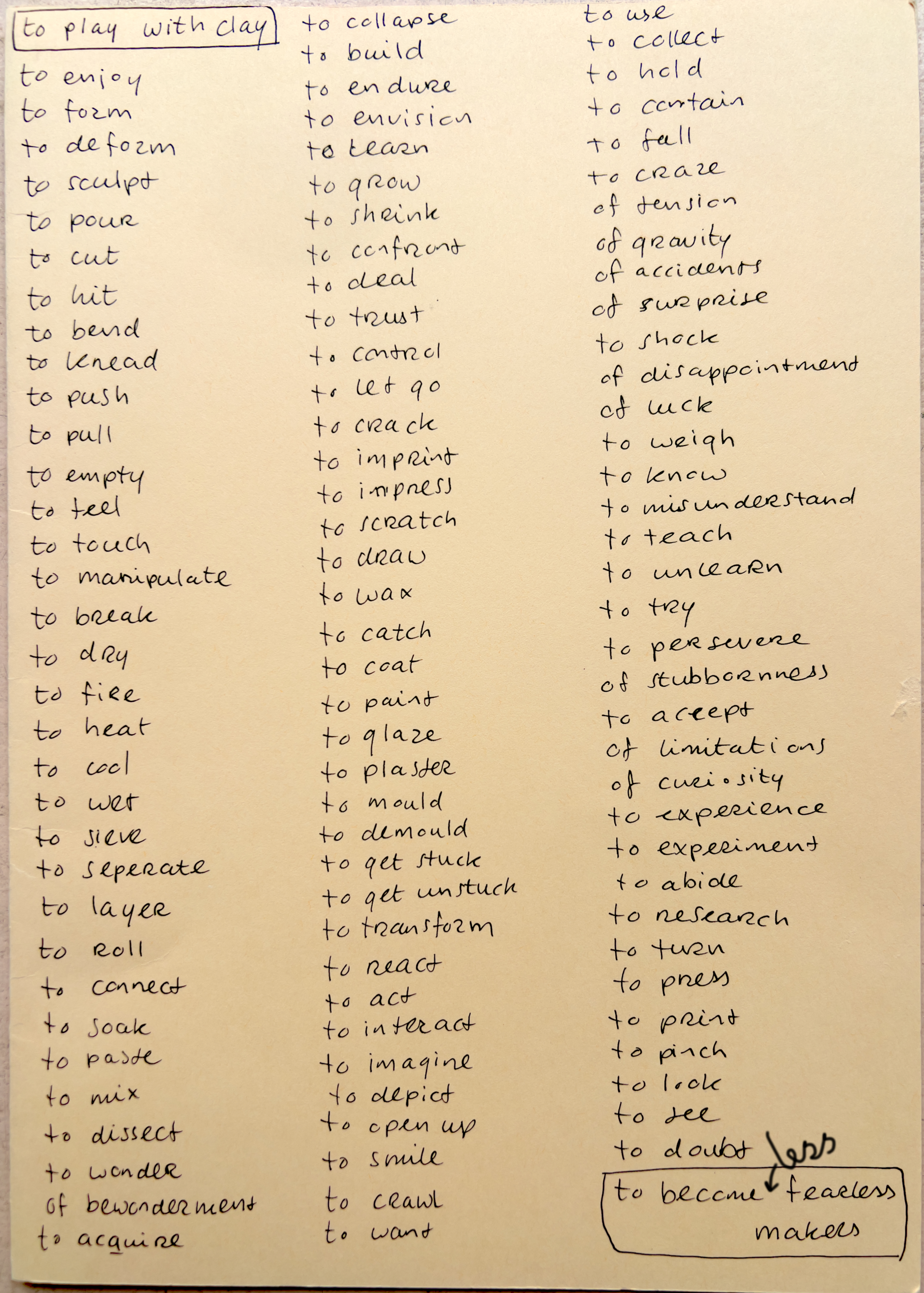
> Creation itself, however, is not a neat, linear next step. It unfolds as a looping, often simultaneous process of just acting (!) sensing, iterating, experimenting, researching, sketching, developing practical skills, imagining, seeking feedback, making, perceiving, sharing, reflecting, assessing, revising and...again.
> Creation also brings a wide range of emotions and mental states. By repeatedly experiencing this process, mental blocks are reduced and fear of the unknown decreases. Because the future is inherently unknown, mastering this creative process is a valuable and practical skill.
When? Where? Price?
When? 4x consecutive times for 3 hours starting on Wednesday, Saturday or Sunday.
Where? Westerdok 780 Amsterdam = 1 km walk from the Central Station.
Price? €300,-
The week before you start I will sent you some ‘wake up the senses’ assignments, to help you open-up to the world around you.
Each workshop will have 3 parts dealing with idea, senses and instinct in alternating order.
How doing by making helps any process?
- Sensorimotor coupling: touch (weight, texture, resistance) provides immediate feedback that alters perception and thought and sparks new ideas.
- Externalization: sketches, models and tools record ideas outside your head so you can repeat, adjust and improve them.
- Iteration and experiment: quick making, adjusting and testing lowers the cost of mistakes and allows for surprises.
- Learning by doing: skills grow through repetition; techniques become bodily knowledge (procedural memory).
- Distributed cognition: knowledge and memory reside not only in the mind but also in people and material resources (notes, tools, diagrams).
- Experiential knowledge and functional cues: materials and tools invite certain actions and rule others out, producing new meanings and directions.
- Incubation: making slows thought enough to allow reflection and new associations.
- Idea diversity: material constraints and conditions stimulate flexible, original solutions.
- Emotional engagement: tangible progress and sensory pleasure boost motivation and perseverance.
- Autonomy and wellbeing: the ability to make and repair things yourself increases independence and contributes to overall wellbeing.
